Wednesday, February 12, 2014

Metal Gods of Ur-Hadad 'zine, Issue #1

Hey! Check it out!

ACTUAL LINK TO PRODUCT (Thanks, +Joshua Macy!)


We're currently at #9 on the RPGNow Top-100.

If you haven't grabbed a copy of the 'zine yet, why the Hell not? It's pay-what-you-want! Go and get it! Consume it with your eyeballs and let it corrupt your mind!

Do it now!

SO! MANY! EXCLAMATION POINTS!!!

Tuesday, February 11, 2014

You know what you need?

 This shit, right here.


The Metal Gods of Ur-Hadad 'zine. Issue #1. 


Get yours now!

And listen to some of this, too. It'll make your ear holes feel good. 


Thursday, February 6, 2014

Effects of Overland Travel in DCC RPG

A recent Google+ post Peter Leban, in reference to THIS BLOG POST, got me thinking about a subsystem for DCC.

In my experience, it's pretty rare for judges to really keep track of things like provisions, water, and the like. It's even rarer for them to concern themselves with the longterm effects of travel in the game world. But what if we wanted to do that, to introduce environment as an opponent, an enemy just as dangerous as a monster the PCs might face?

Think about it. 

The PCs are riding (or marching), at speed, for days. They've barely rested. (exhaustion)

The PCs are lost at sea, becalmed, and their water is foul. (deprivation)

The PCs are fleeing (or chasing) through a hostile environment (desert, snow, whatever). Though they have supplies, they need to be rationed for the long haul, and the endless marching is wearing them down. (deprivation and exhaustion)

In each of these cases, the PCs are trying to achieve a goal of some kind, and their ability to endure their circumstances is being tested. Certainly such a test should have some effects on the PCs, right? I mean, if you spend three days on a forced march, with little food and no rest, you're probably not going to be in very good shape to fight when you reach your destination. How do you model that, mechanically?

One option would be to model this on the Spellburn mechanic in DCC RPG. Reflect the cost of journeying (or whatever durance and/or deprivation) astemporary attribute loss (to Strength, Stamina, and/or Agility). When any of these goes below a threshold (say, 3), then the PC is unconscious. You could also tack on actual damage to HP if that happens, or permanent stat loss, or even death, if the circumstances suggest it. 

For example, the PC is fleeing through the desert, pursued by X. He has no water or food, and cannot stop to rest. Maybe for each of those factors, for each period of travel (whatever that might be, perhaps half a day), he loses 1d4 or 1d6 attribute points from each attribute (with saving throw, modified by current attribute, for half loss). At some point, it might pay to turn and fight X, instead of fleeing. If the PC continues to flee, he may become exhausted (reduced STA), weakened (reduced STR), and/or lack of mobility (reduced AGI).

Further, the PCs might find that their ability to fight or cast spells is reduced (via lost attributes), leaving them even less able to deal with whatever it is that they must face.

If we assume that some environments (more extreme ones) are more challenging than others (milder ones), perhaps we could use steps on the dice chain to represent the relative advantage/disadvantage conferred by environment. If the PCs have supplies and equipment that allow them to mitigate the environmental factors, then that also could be represented on the the dice chain.

First, let's make an assumption. Each half day of normal traveling costs 1d3 attribute points in Strength, Agility, and Stamina, with any extras taken from Stamina. This is the base die in the chain. 

Then, we consider aggravating and/or ameliorating factors. They have no food (+1 on dice chain), they have no water (+1 on dice chain), but they have beasts of burden to carry some of the their load (-1 on dice chain). I'm keeping this to a simple +1/-1 just for the sake of simplicity. I'm sure there could be other numbers. These just keep it simple to use and remember.

Factors that aggravate or ameliorate circumstances of travel could be environmental (weather and climate, geography), circumstantial (supplied for environment, or not; encumbered, or not; wounded, or not), and so forth.

The idea, in the end, is to encourage the PCs to think about resources and capabilities, and to make choices that reflect the actual circumstances. How the hell, for example, could a group of PCs march three days through the desert, in mail, carrying 30,000 gp, without water or rations, and then arrive at a crucial battle, ready to fight? That's silly. They'd be exhausted, at best. Hell, they might be dead in the desert, food for the vultures and jackals.

Does this seem like a reasonable system to model such circumstances?

Saturday, February 1, 2014

The Vancian Wizard in DCC RPG

I chance to read this excellent post over on The Evil GM, today. Given my proclivity for all things DCC RPG, it drove me to reflect on the magical mechanics of that particular system. It seems to me that magic in DCC RPG, while still "Vancian" in flavor, has been altered sufficiently to ameliorate some of the problems associated with that sort of system. Here are a few of the "fixes" I've noticed:

The Dice, The Dice, Oh, Lord, the Dice!

I must begin with the most important difference: The role (roll?) of chance in the DCC RPG magic system. Those already familiar with my work know that I love dice and the chaos they bring to this game, for good or for ill. Nowhere is that more apparent than in the magic system.

Scaled Randomization of Spell Results

First of all, unlike D&D and its various clones, casting a spell doesn't succeed automatically. And, even if it does succeed, saving throws are still possible. DCC RPG creates the possibility of spell failure through the Spell Check mechanic. Here, the wizard rolls a d20, modified by Intelligence and by Caster Level. At the lower levels, the caster must achieve a "12" result on the die roll for a bare success. Higher results, as I'll discuss presently, mean better (more powerful) outcomes. At higher levels, the caster must achieve higher results for the bare success (18 for 5th level spells). This sort of scaling of the randomized results makes it easier for high level wizards to succeed with lower level spells, but preserves the difficulty logically following from the idea that it is a higher level spell.

Every Wizard is (potentially) a Nuke

Even more interesting, even a low-level wizard is capable of amazing successes. For example, a first level wizard could, with an 18 Intelligence, achieve a result of up to 24 on a spell check roll. Let's look at Magic Missile.

With a "12" result (bare minimum success) he or she would get the following result:
The caster throws a single missile that does 1 point of damage. He must have line of sight to the target. The missile never misses, though it may be blocked by certain magic (e.g., magic shield).
With a "24" result (maximum without Spellburn or Luck Burn), he or she would get this:
The caster throws a single powerful missile that does damage equal to 4d12 + caster level. The missile must be aimed at a single target to which the caster has line of sight, at a maximum range of 1,000’. The missile never misses, though it may be blocked by certain magic (e.g., magic shield). (Both results, DCC RPG Core Rules, p.145)
That's a pretty kick-ass result, comparatively, and some of the ones in between are pretty amazing as well.

So, any wizard, from 1st level to 10th, has the potential to demonstrate amazing arcane abilities. He or she also can augment those abilities with sacrifices of various sorts.

Spellburn and Luck Burn

Sometimes, sacrifices must be made to ensure (to the extent possible) success. In DCC RPG, the character can do this by two mechanics: Spellburn and Luck Burn. Spellburn allows the wizard to sacrifice Strength, Agility, and/or Stamina to increase his or her casting roll. Those losses are real, though temporary. The lost abilities can be healed at a rate of one point per day of rest. In the mean time, any rolls relying on those abilities would be at an adjusted modifier for the ability in question. For example, a wizard who burns 3 points of Stamina might go from 10 to 7. The new modifier would be a minus-1. The result would make his or her Fortitude Save somewhat less likely. So, the Spellburn mechanic allows wizards to burn vital essence to achieve supreme results, but at a cost.

Depending on what happens later, early use of Spellburn might turn out to be a very, very bad idea. The wizard may find him or herself handicapped significantly in a save-or-die situation. On the other hand, Spellburn might be the thing that turns the tide when things start to go to shit. This, I must say, is one of the best things that this approach makes happen: The noble sacrifice of the wizard can turn a can't-miss TPK into a resounding victory for the party. The wizards Formerly Ian and Jerkal the Blazin' (RIP) have provided good examples of that, in the Metal Gods of Ur-Hadad campaign.

Also, a natural "1" roll (a fumble) while using Spellburn, has additional consequences:
Any magic-user who rolls a natural 1 on a spell check while using spellburn suffers the loss of ability points and the associated corruption (see below), and also loses 1 point of ability score permanently (DCC RPG Core Rules, p. 108).
Luck Burn, on the other hand, is something that any character class can use. It is, simply, sacrificing points of Luck (permanently, in most cases) to add to a Casting Roll. Luck gets used in a lot of ways, though different judges may have their own eccentricities in this regard. I, for example, have taken to using Luck to determine who will be attacked first, when there is such a determination to be made. Luck also may be used to see if characters notice things, or whether they find more or less treasure, or whether their mounts will bolt or stand their ground when startled. There are lots of reasons to need high Luck, not the least of which is the Recover the Body mechanic:
If a character reaches a dead ally’s body within one hour, the dead character may make a Luck check when his body is rolled over. On a successful check, the dead character was badly injured but is not permanently killed, and the ally is able to keep him alive. The “dead” character was simply knocked out, stunned, or otherwise incapacitated. (DCC RPG Core Rules, p. 93) 
With a low Luck score, the chances of surviving a Recover the Body check decrease. Low Luck can mean you are Dead, Dead, Dead, pal. Tear up that character sheet, buddy. Better luck with your wizardry next time, champ.

Spell Failure and Spell Loss

When the casting roll doesn't succeed, there are a couple of different things that can happen. The first is simple failure. The spell didn't have an effect. On top of this, the caster will usually lose the use of that spell. This is about the same thing that happens in the "traditional" Vancian spell casting. You use it, you lose it. In DCC RPG, however, the caster may Spellburn to keep a spell that has been lost via a failed casting roll. "If a wizard expends a lost spell’s level in ability score points, he can cast the spell as if he still had it. For example, a wizard could burn 2 points of ability scores to cast a level 2 spell he had lost for the day" (DCC RPG Core Rules, p. 108). Spellburn, though, as I've already suggested, has its own associated problems.

Misfires and Corruption

One of the things I love to see as a DCC RPG judge, is a natural "1" result on a Casting Roll. This means that something fun is probably going to happen. If it does, the wizard (and his or her party) may find themselves, as the bard said, totally fucked.

The wizard in question must make a roll to determine what happens on a natural "1" result. A misfire is an unintended effect. On a Sleep spell, for example, the misfire might result in the wizard (or entire party!) being put into a magical slumber. A Magic Missile might result in untargeted creatures (including the wizard) getting hit by the spell.

Misfires are fun. Misfires can be hilarious. I love, love, love misfires. Then again, I rarely play wizards.

Corruption is another matter entirely. Corruption is when the spell has the unintended effect of altering the wizard. It also, sometimes, could end up altering others in the area of effect of the corruption. In a word, if you mess around with magic, Son, don't be surprised if you get bit. By a viciously toothed maw. The maw that just appeared on your forehead. Look at the little children run away from the hideous freak wizard. Look at the villagers with their torches and pitchforks. And, Lo! Is that a hangin' tree? Is that a rope? Run, wizard, run!

Corruption is also fun. Yay, corruption!

Supernatural Patrons

Finally, wizards have access to supernatural patrons, and these patrons also can grant the wizard new spells (and new corruption results--i.e., "patron taint"). This unnatural congress will (of course) cost the wizard. One doesn't traffic with Angels, Daemons, and Beings Between without an associated risk that it will cost, and maybe cost more than one can bear.

The wizard will rack up obligations to his or her patron(s). The wizard be corrupted into the patron's image. The wizard may, ultimately, become puppet to the patron, with all that implies. These are not nice people. They want just (or even unjust) recompense. They will have it, whether or not the wizard can bear it.

Wizards, of course, are not the only spell casters in the game. Elves function pretty much as wizards do. Clerics, though, have another system entirely. They don't have spell misfires or corruption. They accrue Deity Disapproval. Such disapproval may obligate the cleric (as to a patron) to accomplish particular goals for the deity. It may strip the cleric of particular powers, or make it more difficult to access them.

I will not, at this time, go into the disapproval mechanic for clerics. It's beyond the scope of the current post.

Conclusion

DCC RPG's magic system, while ostensibly Vancian, takes "Vancian" to mean something different than D&D did with its magic system. In fact, one could argue that the DCC RPG magic system is far more explicitly Vancian than the D&D counterpart. Overall, I think it's my favorite system of the two. I embrace the risks and rewards. I like the way that supernatural patrons are incorporated. I appreciate the corruption rules that change the wizard in manner and/or appearance. These features, among others, make the DCC RPG "Vancian" magic system a close approximation of what is suggested by the Vancian literature.


Tuesday, January 28, 2014

Metal Gods of Ur-Hadad 'zine coiming soon!

I'm a bit late on this, but here it is: The (we hope) highly anticpated Metal Gods of Ur-Hadad 'zine, Issue #1.

http://fromkickassistan.blogspot.com/2014/01/metal-gods-of-ur-hadad-zine-issue-1.html

We still gotta get cleared by DCC heaquarters, but it's ready for primetime (taking into account the small sample sizes and whatnot)


Sunday, January 19, 2014

What are the Lost Hymns?

+Adam Muszkiewicz first came up with the idea of the Lost Hymns. I've used them as a play element in my Last Dance of the Disco Lord adventure I ran (and posted) in December. But have you ever thought would it would mean for a cleric, particularly.

We are adherents of the Metal Gods (mostly) in the Metal Gods of Ur-Hadad campaign. Also, to make clear, "Metal Gods" refers the deities, not the PCs or the players (though we try every day in every way to reach ascension). So, think of every heavy metal song. Every one. It has music, and most have lyrics. Those lyrics are sometimes stories, sometimes nonsense, sometimes an anthem to a person, place, or thing, and somtimes to a lifestyle or ideal. These songs are sometimes cryptic, and sometimes explicit. They form a somewhat nebulous body of the Metal Gods' wisdom. The borders between what is truly holy and what is not, are not clearly drawn. There is always dispute about that fact, a quite durable state of affairs, at this point, and not much likely to change. In fact, what some call "metal" may be seen as "not metal" by particularly vehement, orthodox worshippers of the Metal Gods.

This body of knowledge is unevenly shared, even among worshippers. There are always new ones to learn, and even the greatest of the Metal Gods' clergy do not know them all.

However, these hymns are not the basis for divine spells or other effects. They simply are wisdom, and provide a sense of perspective, values, and a variety of orientations to the world and one's place in it. They allow you to figure out what kind of cleric you might have. Or better yet, the kind of cleric you have should tell you which of the hymns are most sacred. It's just a simple way to get into character. If you like pirate metal, for example (e.g., Alestorm), as I find I do (did not know this about myself, and am a bit surprised to tell the truth).

Here's an example:

It's got pirates versus vikings. Fun!

With lyrics like this, it's pretty easy to see why that sort of cleric would make a pretty decent adventurer:
Back trough time, to fight the viking foe! Back trough time, where our voyage must now go! Six hundred years into the the past, Our desitny is here at last! For infamy and plunder we will ride!
The Lost Hymns, though, can only be learned from one of the Metal Gods pantheon. These are the Great Ones, the Avatars of Metal, gods like Lemm, Robhal, and Iod.  Learning the Lost Hymns these gods can reveal requires particularly avid devotion, and are granted only in great need for pursuits important to the gods, themselves. Typically, access to the Lost Hymns requires that the cleric call upon that particular Great One, by beseeching Divine Aid, as per the DCC RPG rules:
To request divine aid, the cleric makes a spell check at the same modifier that would apply were he casting a spell. This extraordinary act imparts a cumulative +10 penalty to future disapproval range. Based on the result of the spell check, the judge will describe the result. Simple requests (e.g., light a candle) are DC 10 and extraordinary requests (e.g., summon and control a living column of flame) are DC 18 or higher. (p. 31)
It's also important to recognize that such a petition for aid must be extraordinary, and that frivolous petition for access to the Lost Hymns may have dire consequences (e.g, in the form of penance of some kind, a divine smiting about, etc.).

Success in beseeching divine aid means that the cleric has access to a Lost Hymn. It's up to the Judge and the player to figure out what happens. There's only one real requirement I'd impose (as a Judge) beyond the good roll: As a player, you should have a lyric in mind that will serve as the basis for the effect you hope to achieve.

In fact, it might be neat to have clerics of the Metal Gods rename their particular, known spells based on a lyric that suggests the spell effect. Since my cleric still lives, I'll have to ponder that for a while, to come up with particulars. One could even limit spells one can learn, based on what's "canon" for the particular sect of Metal to which the cleric adheres.

Anyway, not necessarily relevant outside of the Metal Gods campaign, it at least illustrates how to use even the simplest "literary" sources as inspiration for character-building and roleplaying.

Godly Grace in a Mortal Shell

Yesterday, while playing in +Shawn Sanford's DCC FLAILSNAILS game, my longest-running DCC character, Kormaki Lemmisson, almost met his end, and at his own hand.

Here's what happened.

We'd gotten very nearly to the end of Michael Curtis's excellent adventure, DCC #77 The Croaking Fane. Only a couple more rooms to look at before heading back to Punjar to heal up and resupply before tackling Emirikol Was Framed. Surely, that wouldn't be a problem, right? It's just a couple rooms. We could handle it, right? Very nearly not, it would turn out.

The room at issue was behind a barred door. The door was barred to keep whatever was behind it, well, behind it. +Barry Blatt noticed that small fact, and advocated for a swift retreat with our ill-gotten loot. In our hubris, in our greed, we ignored his wisdom.

In part, I ignored him because of my success in casting a spell. After we removed the bar, revealing some kind of crypt behind it, Kormaki cast Divine Symbol, a spell that imbues the cleric's symbol with holiness. Here's the result of the casting (a natural 20, btw):
For a duration of 3d6+CL rounds, the cleric can attack with his holy symbol as if it were a magical weapon of +2 enchantment. It deals 1d14+2 damage (modified by Str, as usual), with an additional +4 damage bonus against unholy creatures. In addition, as long as the cleric is visible to his allies and followers, they receive a +1 bonus to saving throws and morale checks. Finally, the cleric also receives a +4 bonus to all spell checks to turn unholy while using his holy symbol when under the influence of this spell. (DCC RPG Rulebook, p. 275)
Time to kick some undead ass, right? Kormaki had Soul Power (for 19 rounds!), and, yes, was most assuredly feeling Superbad.

Unlike Kormaki, JB understands how things can go, sometimes: Super-badly.

In the end, Kormaki had only himself to fear. After initially having great success in dealing damage to his undead, amphibious foes (big-ass zombie frogs with like a million HD), and failing to turn unholy (because of those many, many hit dice), Kormaki lined one of those bastards up in his sights and swung mightily. He rolled a natural 1 (of course). Subsequent rolls on the fumble table (d16, because: Banded Mail) ended with him doing 12 points of damage... to himself. He was also (of course) the only cleric in the party, so no healing for him. There were some potions we found, but I had the feeling they wouldn't be very healing, so I gambled, and declined such aid. 

I (Edgar, not Kormaki) suddenly found myself reflecting on the real possibility of the death of my oldest character. Kormaki has been around since the Metal Gods crew started playing together. +Adam Muszkiewicz doesn't exactly shower us in unwarranted XP, and he and I alternate judging duties, so it's taken me a long time to get him to 3rd level. He's a veteran of Fort Simian. He's met Space David Bowie, in his Ziggy Stardust aspect. He smoked the purple tentacle, for Lemm's sake! He's been through some shit, let me tell you. How could he die? Who might replace him? My mind pondered these possibilities as the rest of the party mopped up, and watched Kormaki bleed out, helpless to do anything about it.

But there was a possibility that he might still live--the "Recover the Body" rule:
Recovering the body: If the body of a dead ally can be recovered, there is a chance the ally may not be truly killed. He may have been knocked unconscious or simply stunned. If a character reaches a dead ally’s body within one hour, the dead character may make a Luck check when his body is rolled over. On a successful check, the dead character was badly injured but is not permanently killed... (DCC RPG Rulebook, p. 93)
Now at only 7 points of Luck, Kormaki's chances were a bit slim (35%) to "recover the body" as per the rules. The Metal Gods smiled upon him, and the Iron Fist of Lemm did shelter him from harm: I rolled a 2. 

So, Kormaki lived. He's down (another) point of Stamina, reducing him to 8, and incurring a -1 penalty as a result. He suddenly feels like that cop who's three days from retirement, and "too old for this shit." He needs to go back to the chapter house, to heal up, to drink and whore, and to do all of those things a man of his stature ought, before things go pear-shaped for good. 

Knowing how things go, though, he'll probably just go out adventuring again. His inevitable demise is only a matter of time. In the end, death waits for us all.

Dax, baby? Sing us out. Sing something about death.


Maybe you're dead and ya just don't know
A shadow dressed only in sorrow
Tomorrow might not exist and ya should've been dead


Wednesday, January 15, 2014

Clerical Error?

I was listening to the latest installment of the Spellburn podcast, this morning, as I was taking a run. If you like DCC (or think you might) and aren't listening to this podcast, start. +Jeffrey Tadlock, +Jobe Bittman, and +Jim Wampler do a bang-up job on it, and I've learned a lot from listening. It's also pretty entertaining, so there's that as well. Anyway...

This episode features DCC RPG artist (and new Metal God), +Doug Kovacs. He said something that got me thinking, about how he's been playing his clerics (to the hilt, up to eleven, pick your own metaphor). Basically, he plays his cleric as if that cleric actually gives a shit about his god, and wants to advance his god's agenda. Zealously. No matter what the situation. No matter the consequences. His clerics are True Believers, and expect no less from everyone else. Doug observed that playing a character that way makes the rest of the party begin to wonder whether or not its really worth having a cleric in the party.

Here's a fun example. Sister Crack (priestess of the Gravel God) is committed to overthrowing social hierarchies. She's like a bomb-throwing anarchist, and she's not what you'd call subtle about it. She's the sort of character that, if the party was trying to slip through a guarded gate, in disguise, would call the guards "fucking pigs" or "tools of The Man." Totally in character. Totally correct. Totally NOT HOW YOU WIN THE GAME. I must say, I love that stuff. My character, on the other hand, is like, "What the hell, woman? Shut it! You're gonna get us killed!" Friar Tuck, she ain't.

Now that I've seen it happen a few times, I find it kind of fascinating, because playing a cleric like that is so very unusual in many games. It seems like, for most people, a cleric is pretty much like a wizard with some healing magic. That's probably at least some of the reason some folks suggest that clerics aren't needed in an RPG, and should just be another kind of wizard. People don't embrace their gods, and they don't believe in the ways that True Believers do. It's kind of self-defeating, if you think about it. What priest of a god doesn't really want to be a priest, or do priest stuff, or get other people to follow the god and its teachings, or... you know... be a cleric? In my experience, most people who play clerics, don't play their clerics as zealots.

The reasons they don't, in metagame terms, are pretty obvious. Zealous clerics are a pain in the ass. They're you're uber-religious aunt, come to dinner. You're trying to eat your meal, get your drank on, and whatnot, and she can't shut the hell up about Jesus (or crystal magic and how "spiritual" yoga is, for that matter) for five fucking minutes and just have some fun. Worse, she wants to bully you into sending your kids to church. She questions whether you, as an unbeliever, can ever really be happy, or even have a real sense of morality. Her world begins and ends with her religious beliefs (whatever they might be). She thinks everyone else's lives should be like hers, as well, and she ain't gonna go quietly about her business and leave everyone else alone. Unbelievers ARE her business. Making them into True Believers is her vocation.

Add to that equation the fact that there's a financial/power side to religion (looking at you, TV preachers), bringing in more True Believers means having fuller coffers (and having to buy even more coffers to fill). It means competing for power on par with kings, princes, and pashas. It means dominion over daily (secular) life. It means holy armies. It means holy war. It means this:
We came down the Avenue, ten thousand strong, filled with the Bloodfire, swords flashing in the light of dawn. And there they stood, the hated, the blasphemers, the vile and filthy Medicari, arrayed in their pristine bandages and aromatic unguents, and bearing caducei. In their wickedness, they bind the flow of the Sacred Wine, denying it to Gorus Na'al. Such audacity could not stand. We slew them to a man, though thousands of our brothers and sisters fell that day. Each of our martyrs died smiling, for Blood ran in the gutters where they lay, ran in torrents like the runoff from a summer storm, and the Medicari learned well that true cleansing can only come from opening wounds, not from binding them. (The Bleeding of the Medicari by Primate Jacurus of Gorus Na'al.) LINK HERE
 Yeah, so Doug knows how to play a cleric: You know, like a cleric.

I played a cleric like that in my friend Kyle's D&D game, back in the early 1990s, and that campaign started with us getting abducted and sold into slavery (after we spent like two hours rolling up and equipping characters. Haha, Kyle. Really funny.). His name, like my current cleric, was Kormaki. He felt compelled, because of that experience, to (1) kill lots of slavers, (2) convert lots of slaves, (3) establish shrines and temples with the help of his new followers. It was a great campaign, one of the best I've played in.

Strangely, I'd sort of forgotten how to play a cleric, since then, though I did a creditable job in my buddy Jason's Dark Heresy campaign (but that's canon). I think I needed another reminder how it's done. Thanks, Doug!

You know... it would really fascinating to play a party made up only of the clerics of a single god, and maybe few True Believer templars, to add a little buckshot to the bucket of spit, so to speak. They'd probably end up getting killed, simply by pissing off too many of the wrong people, but if they found the right congregants... boy would that be fun. To paraphrase Archimedes (I think), given a lever and a place to stand, they could move the world.


Cave Evil is En Route

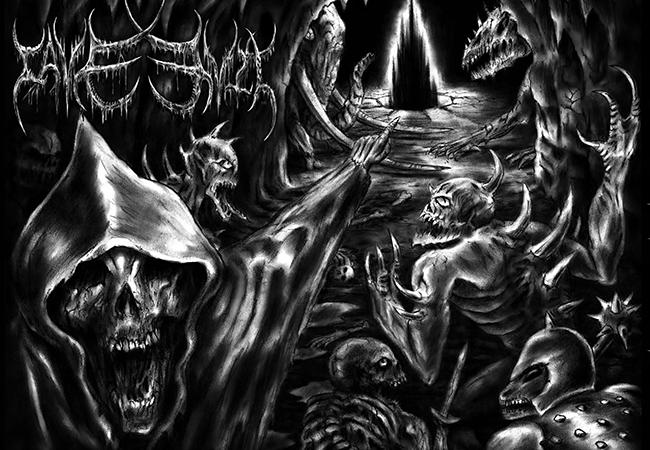
Have you heard about Cave Evil?

I pre-ordered this thing last summer and hadn't heard a peep from the producers since. To be fair, they have a Facebook page, but I don't really pay much attention to Facebook, so I missed the various updates. Just got my shipping notice today. I imagine I should have it by this weekend. In any case, it was so fucking metal I had to buy it, and I'll review it soon, here on the blog.

Sooooo metal, even Death is like, "Dude! Check it out!"


Wednesday, January 8, 2014

New Year's Resolutions-Gaming Edition

So, it's the New Year. Of course I have my share of "standard" resolutions, one of which involves a bit less beer and food, compared to the holidays, and maybe a bit more exercise. Boilerplate stuff, really. I also have a list of gaming-related resolutions.

Start doing a bit more with magic items of various sorts. The spells for making potions and weapons are in the DCC RPG rulebook for a reason. Why not use them (or variants thereof) to my advantage. Our guys are starting to get to higher levels, and they seem to have some cash on hand. So, why not? I've been particularly interested in the potions. I could see a "Potion Mishap" table coming out of this interest.

Finish writing Goloch-Ka, my exploration of the origins of the elven menace on Planet Ore. My maps are done. My hexcrawl has been conceptualized (though I still need to do that map, come to think of it). I've written some pretty great monsters. Now all I have to do is key the maps and start playtesting. That'll take a while, but it's a labor of love.

Play more DCC RPG with all the groups of which I am part, online and off. One reason I hate the holidays is it breaks my routine. I'm a creature of habit and am most productive when I can get into a groove. This is difficult during the holidays because there are no set routines. Everybody's schedules get chaotic. I haven't been able to game nearly as much as I like to, and it bums me out. More games!

Make  it to more FLAILSNAILS games. I've done some great gaming with +Shawn Sanford, and recently got to play Dying Earth with +Barry Blatt. I've really enjoyed both, but haven't been able to do it as consistently as I'd hoped. I think I can do better. I have a lot of fun gaming with their crews of ruffians, and need to so more often.

Blog more. I've been a shitty blog-master the last month or so. I haven't written nearly enough content. Partly that's because I've been doing work for Goodman Games, and partly because my actual job has been particularly challenging, and partly because vacation left me a tad dragged out and unmotivated. This needs to change. When I make myself write, I find that other things improve as well.

Finish my research proposal for gaming-based research. I've been making noise about it for a while, but I really am gearing up to do some research related to gaming, particular with regard to hangout gaming, gamers' influences, and a variety of other topics. I need to get my proposal finished, approved by the institutional review board, and start recruiting participants for the research. If you're interested in participating, let me know.

Get my ass to GenCon. I've got my hotel reservations, and am waiting patiently to do airline tickets and badges. This shit is going to happen. I've never been to any sort of gaming con, so this is new and exciting. Plus, I'll get to meet (finally) +Adam Muszkiewicz and the lovely and talented +Kathryn Muszkiewicz, +Doug Kovacs, and the rest of the DCC crew. I'm also hoping my boy +Wayne Snyder will be able to make it again. I was really jealous at the tales of their various exploits, last year, and pledged that I wouldn't miss out in 2014.

Do a great job on this other project that I'm not at liberty to discuss right now, but about which I'm so very, very excited that I could just about poop myself. More on this later. Much later.

And, most importantly, make another go of gaming with my daughter. The first round didn't go particularly well, and I think I, personally, can do better. She maybe isn't a good fit for my regular, face-to-face group, but I certainly can run something solo, or for her and her friends, and make it fun and totally awesome. She's already interested, so there's not reason I shouldn't.

This is a pretty good list, but I think it's doable. Nothing like a low/medium bar to gauge success.