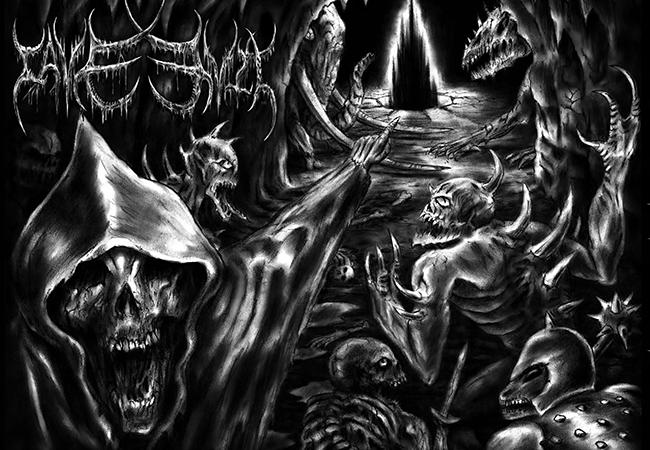
In an earlier post, I crowed a bit about receiving my copy of Cities of Darkscorch, but it wasn't until last night that I had a chance to play it. The wife and child joined me for fantasy rockband madness, as we dodged the blacklist, dueled with opposing quartets (and each other), and tried to get ourselves to Numenor for ultimate battle. Short version: It was fun.
Long version
The game is a turn-based boardgame. The contents consist of:
16 wooden counters imprinted with the name of a band (the bands on the Warfaring Strangers: Canticles of Darkscorch compilation). I got Stoned Mace, the wife got Wrath, and the daughter got Medusa.
3 dice (d4, d6, and d20)
25x25 inch game board (not shown below)
2 decks of card (Fate cards and Foe cards)6 "city banner" cards with sliding windows
Warfaring Strangers: The Darkscorch Canticles double LP, with band bio insert
CD of Warfaring Strangers compilation
Box Contents (not including game board or double LP)
The production quality for everything included is very good. The double LP cover and insert are extremely nice, as is the box that everything comes in. Some of the game pieces (especially the banner boards) are not as well-made, but nothing aggregiously terrible. The art style is simple, and invokes a sense of nostalgia. I can totally see this stuff drawn on a school notebook or on a backpatch. I mean, seriously, look at that wizard on that chopper! The main gripe I have is the choice of fonts used for the flavor text and city markers. They're quirky and in-theme. They're also pretty hard to read, at times, which can get in the way of fun. For example:
Reading this stuff can be a pain in the ass, and the little windows don't like to stay put.
Same font used on game board. Also a pain in the ass.
Gameplay itself is very simple, and reminds me a little of Munchkin (but only a little). Here are the basics:
You place your counter on the "City" written its reverse side. This is your home city. You must win a battle in your home city and claim that city's "banner" before you move out onto the board.
Each player gets three Fate cards to start, and can get more through battles or by landing on particular board locations. They include advantages, disadvantages, transportation, new band mates, and getting placed on (or getting off) The Blacklist.
Battles require you to go head to head with an opponent from the Foe deck. Draw the card and roll a d4. At the bottom of the foe card is a list of symbols each with an associated number. So, a "2" shows an "X" symbol and a 17. This is the drummer, who has a value of 17. You must roll the Battle Die (a d20) and get that number or above to win the battle. Defeating the foe also entitles you to receive 1 or more Fate cards as loot.
Fate cards can be played during a battle to enhance a roll. You play cards that give you positive modifiers. Other players can throw down cards to give you negative modifiers, just to screw you over. Many a battle was lost, last night, because of this. To be fair, though, other players can certainly work to help, as well.
If you win a battle on a city space, you win a banner from that city. You must collect all 16 banners to make it to the final battle, in the city of Numenor.
The first player to get 16 banners advances to Numenor, and is immediately joined by every other player. This person is the headliner. You don't get to be the headliner if you haven't acquired the 16 banners.
Once in Numenor, everyone tallies a band score, including the bonus numbers of any band members those on any advantage cards. You also can play your disadvantage cards against the headliner (at least that's how we did it).
To battle, everyone rolls a d20 and adds the band score. If the headliner wins the roll, the game is over. If not, he or she must leave Numenor (moving at least one space outside) and return to try again.
Going for atmosphere
As I said earlier, the game is a lot of fun. The cards are often pretty damned funny (and a bit bawdy), with references to sex, drugs, and rock-n-roll. I found myself laughing at a lot of the cards as we played the game. One example:
Again with the hard-to-read font.
Overall, I have to say I'm glad I picked this up. We had a lot of fun playing it with three people, and I think it would be even better with four or five. That would provide more opportunities for PvP battles, and chances to screw over the other players (which is always fun).
So, to summarize. Simple, easy to play, fun, and pretty well-conceived game. I'll play it again.
I pre-ordered this thing last summer and hadn't heard a peep from the producers since. To be fair, they have a Facebook page, but I don't really pay much attention to Facebook, so I missed the various updates. Just got my shipping notice today. I imagine I should have it by this weekend. In any case, it was so fucking metal I had to buy it, and I'll review it soon, here on the blog.
Sooooo metal, even Death is like, "Dude! Check it out!"
With all my peeps up at GenCon, gaming has been a bit sparse of late. On top of that, the school year is revving up again, and I'll be returning to the classroom after a three-semester absence for administrative work. Take those things together, and I haven't had much to post on the blog, lately.
However, I recently received my copy of +Greg Christopher's Ambition and Avarice, and wanted to provide a quick review and some editorial feedback for Greg (not solicited, but hopefully recognized as a good-faith statement on my part).
Given the sheer number of D&D-like products that have been produce by the OSR community over the last few years, any new offering in the "original fantasy" genre would have to do a few things differently, and Ambition & Avarice does so.
Characters
The first difference in A&A is the available player character races, which include "barbarian" races like Orcs, Hobgoblins, and Lizardfolk, among others. This opens up the ranks of player characters to characters taht could take your campaign in a vastly different direction. Here, we have "monster" races, and the ability to figure out what makes a "monster" campaign work differently from a campaign with only the "normal" races included--Or, perhaps, exactly the same: We're all murder-hobos here, after all. It's also nice that the different races actually manifest unique traits, with real in-game mechanical effects. For example, Dark Elves are good with poisons and with lock-picking. Dwarves are good at recognizing unusual stonework and finding traps.
A&A's take on the "normal" player character classes is also pretty cool. The game dispenses with clerics entirely, making them another sort of mage. Frankly, I like that approach. Even though a play a cleric in many games, I've never really understood why clerics had to be a separate class. They're magic users, pure and simple, but their magic is in a particular vein. Hence the Priest, Shaman, and Cultist magic using/religious classes, each with its own particular twist on the magical and the religious. This is true across the selection of classes provided. Something particularly new, though, is the notion of class-specific "companions"--henchmen/followers in the player character's service. These are mechanically intrinsic to the class itself, and not something related to 9th level domain play, as in D&D. I like this a lot, as it makes explicit the ways in which one learns the trade of fighter or priest or thief, and makes the PC a bit more... heroic in tone.
Updated Game Rules & Mechanics
Greg's take on the regular ways of accomplishing combat, magic, and dice rolling mechanics, generally, is somewhat different from normal. Yes, it's still a combination of d6 and d20 mechanics, but articulated in a way that is updated and somewhat more rational than the Original Game and its closest imitators. I'm not going to enumerate every single instance of this, as A&A has revamped a lot of the mechanics for doing what we do when we loot a dungeon. Here are a couple of brief examples.
Some mechanics are aided or focused by specific items of equipment. For example, a crowbar makes it easier to force doors. A helmet makes it easier to survive "blast" effects.
There are a lot of these little things, many of which are only modest changes to how things work in other games, a focused exposition of the results of this particular author's experiences as a GM. They may work differently from "normal," but you get the sense that it's not just because Greg's trying to do it differently just to make it different. Rather, it seems to be the result of what he's learned and how he makes things work better, an expression of his particular wisdom. While not everyone would reach the same conclusions in house-ruling their own flavors of D&D-like games, this ruleset does a nice job of articulating his approach in a clear, well-organized, and explicit way. It's worth reading in full, even if you're an experienced OSR player/GM.
Equipment Lists are Cool
The equipment lists included in this game are actually a lot of fun. They are extensive, specific, and really seem to be oriented toward making players think about what they carry into a dungeon and why they carry those things. Every weapon, armor, or equipment item is not only listed, but explained in ways that make their potentials clear. Again, sometimes these potentials even include linkage to specific types of die rolls are other means of achieving in-game mechanical effects. I think that this sort of thing would be particularly useful for GMs and players who haven't really played an old-school fantasy game, and need to make the shift in their thinking about how to approach such games differently from, for example, 3.x and 4th edition D&D. It's a small detail, but one of those things that makes explicit what many old-schoolers leave implicit. It helps to articulate the difference between these approaches in a way that makes clear that thinking and resource management (and interacting with the environment in general) are important to successful gameplay.
GM Advice
"The Judge," Christopher's take on how to be a GM is one of my favorite parts of the book. He does a great job of articulating what is different about the OSR approach, including discussion of railroading (and why it sucks), maintaining objectivity, the importance of randomness and unpredictability, and articulation of some important basic principles for world-building and sandbox play, and different ways of thinking about "dungeons" as spaces for play. I also like the section in this chapter that deals with "tropes," those narrative devices we use to create a sense of narrative frames and the characters' places in them. There's a lot more to this section, and I encourage you to take a look at it.
He also provides a sense of the reasoning behind his advice, and I think this really adds a lot of value to the product, especially for those players who are less experiences with Old School styles of play. However, even experienced players and GMs will find something to consider and/or use in their own games, in most cases.
Layout and Design
Ambition & Avarice fills a brief and useful 97 pages, including spell listings (though there are no monsters included, which tends to depress the page count a bit, certainly).
The content itself is well organized and features a detailed table of contents. There is no index, though probably a book this short doesn't necessarily need one. Use of color and tables helps to present summary information in a easy-to-spot and digestible manner. You won't have to scour this manual to find out what cool things your character's race or class furnishes, for example: They leap right off the page.
The artwork is black and white, and features line drawings of thematically appropriate content. I like its simplicity. While it's not sophisticated or complicated (or completely overwrought, for that matter), it provides a sense of thematic unity with the textual content. It provides "flavor" more than literal illustration of the textual content.
Editing (My Only Beef)
The only real negative thing I take away from A&A is poor editorial execution. As I read through the text, the number of typos and malapropisms was a bit startling to me. Now, mind you, I'm sort of a stickler about this stuff, as I edit a lot of people's work, so understand that this is something that bugs me a lot more than it might other people. That said, I was pretty disappointed at how poor a job was done in proofreading the document. Prime example: "it's" is not a possessive form; it's a contraction of a pronoun/verb pair. It's important to make that distinction correctly.
Little problems like this are minor, certainly, but after you've seen them ten or so times in the span of two pages, they start to seem like much bigger problems. I've given +Erik Tenkar shit a couple times about this (and, look, he was one of the proofreaders! Hehe hehe...), so it will come as no surprise that this is what I choose to harp on. I make plenty of mistakes, myself, but there's a big difference between doing so on a blog and in published works for which you charge money.
I think it's a good ruleset, and I think the price he's charging is very, very reasonable. Certainly, I don't mean to shit on this product because of the typos. That said, I find them distracting and I think Ambition & Avarice would be a much better product without them. I hope that Greg will take the time to fix these errata for future editions of the book. Given that it's a print-on-demand product, there's no reason not to do so. Hell, I'd be happy to go through and make another editorial pass for him, if he'd like, so I'm not just complaining.
Summary
Neat book
Decent art
Well worth the price of admission
Great starter game for people new to OSR
Some interesting new takes on old mechanics that could be useful to experienced GMs and players
Please re-edit this thing, and be a bit more careful next time.
I don't do a lot of reviews, but I feel compelled to do so in this case. The game I'm reviewing, Nova Praxis, a FATE-based ruleset, is just that good. And the delivery system, an enhanced PDF, is really amazing in terms of its clean aesthetic and overall usability. Color me very, very impressed.
All of the major sci-fi themes seem to be allowed for, from Cyberpunk netrunning to safari-style dinosaur hunting on distant colony worlds. From transhumanists yearning for post-human perfection to body-Puritans who bomb the labs where that post-human potential is realized. The information about the setting is based on a "default setting." You are members of a group of operatives working for one the major corporate "houses" of the Coalition, engaging in a Shadow War against other Houses and their operatives. You do the dirty work that makes things work for the Houses, that keeps people in their places, that preserves the Powers That Be from shame or blame, while further helping them to cement their influence.
The default setting is interesting in and of itself. It reminds me quite a bit of elements of Cyberpunk mixed with with the various versions of the space opera genre embodied in our favorite TV shows, comics, films, RPGs, and other sources. The author is very clear about this in his response to critics claiming he ripped off other systems/settings:
Eclipse Phase didn't invent the concept of the Technological Singularity (ask John von Neumann who first talked about it in the 50's), nor the idea of transhumanity. In fact, Eclipse Phase very clearly "rips off" aspects of Altered Carbon, Revelation Space, and many others. And so did Nova Praxis. And Nova Praxis also goes on to "rip off" Mass Effect, Deus Ex, and other inspirational sources. That's how fiction works.
Yep. Couldn't agree more. Ain't nothing new in the world that ain't been said already, and I think that's absolutely awesome. That's why we can have things that we share. That's why we can make cool things together. That's why subcultures like the OSR exist. That's why everyone can take something old and make it new again in very personal and interesting ways (or, alternately, in stereotypical and boring ways. YMMV.).
Also, props to Mike for doing a great job editing his text. It's easy to read, well-organized, and almost completely free of spelling and grammatical errors. This warms the cockles of my little, black heart.
How useful would this setting be to me?
The setting is detailed and well-realized, and the elements of the setting are diverse. There's a lot to see here, and a lot of possibilities for tweaking the setting to one's own personal tastes. You get bits like this, about the colony world of Proch:
Large reptiles and ferocious mammals still roam the forests of Proch. These large, at times massive, creatures have become a source of much interest for many of the Coalition’s people. The creatures have provided scientists with many hours of amusement, and a gruesome end to more than a few would-be adventurers.
Land of the Lost/King Kong in motherfucking space, people! That's what I'm talking about.
And this about Earth:
Today, it is believed that no human remains alive on Earth. Mankind’s cities are dens of technological terror, shattered wastelands haunted by murderous machines. Even rural areas are patrolled by aerial recon drones that are programmed to kill anything larger than a house cat.
Hello, Terminator! And the possibilities go on and on.
The description of the rest of the setting provides all sorts of possibilities for just about anything from sci-fi and beyond. You could run a fantasy game, for example, or space pirates, or palace intrigue, or bodice-ripper romances, fergawdsake. Now, mind you, you'd have to come up with ideas for your own, but I think most of my readers are already able to do that, and used to doing so.
Given that it's a FATE-based system, you literally can play just about any character imaginable and any setting imaginable. You could be a giant, monster-fighting robot, a hard-bitten investigator, an technomancer, whatever. If you can imagine it, and you can tie it to the sprawling sci-fi setting embodied in Nova Praxis, you can play it. So, bottom line, this is a very dynamic setting. There are a lot of fiddly bits that you could develop to make it into your Perfect Game. You could do that a whole bunch of times. The number of plot hooks available in the setting descriptions just about guarantees that.
What about this FATE thing? Why would I play it?
I'm fairly new to FATE system-based games. I was somewhat put off by it, initially, as it's a bit complex, and the terminology and assumptions so different from what I'm used to. I had to tweak my brain to deal with the idea that The Story is what's important, that having fun means everybody being able to tell that story (not just or mainly the GM). Mind you, I'm making sweeping declarations with that sentence. I know that. I know that all rulesets allow for that, provided that the GM/players roll it that way. However, just like some other games I've been intrigued by in the last year or so, like +Joshua Macy's SFX! system and its various permutations (e.g., Zap! or Zounds!) or +Rafael Chandler's Disciple 12 system for Spite, this is a ruleset that aims at a cinematic/narrative aesthetic for the gaming experience.
What that means for the GM and players is a bit more flexibility in applying the ruleset. The rules are more procedural than canon, if you see what I mean. They don't define what you can do, but how you accomplish doing what you want to do. I like that. I like it a lot. But it took me a few read-throughs of these kinds of games to really grok the point of it all. At first, it seemed to nerf the deadlier aspects of other RPGs, making the games more about cool shit than about consequences of doing that cool shit. Like there's nothing in there specifically about wounds and death and hit points and specific rules for magic and that kind of thing. The flexibility of the ruleset in application actually put me off! Where the hell was the crunch?
However, I've come to realize that was a bit more about the failure my imagination to capture what I could do with the system. It was about me and my players figuring out what's cool for us, not about having to adhere to what I've come to associate with story-gamey sorts of things I don't much care for. I think I had it wrong. I could use the FATE system to play any fucking game I wanted to. That's what it's designed for. If you can't have fun with it, then you probably need to figure out why you are no fun to be around.
Oddly enough, I think I arrived at this insight by playing DCC, which is almost the opposite in terms of how it accomplishes the very same thing: Make the characters awesome and make the setting random and gonzo. Oddly enough, they are very similar in the way they "feel" to me. There's a real sense of wide-open space here, a feeling that I could explore a lot of different territory in gaming. Maybe it's that the main influences seem to be about the stories (e.g., Appendix N fiction in DCC and the codification of narrative/cinematic structure in the FATE system), rather than the rules.
As a side note, I'm intrigued that FATE creates a linguistic/cinematic language to describe gaming behaviors. It uses generic game actions and character and setting building options to allow the players and GM to build and do just about anything, as I've said already. It also codifies that stuff into terms that are of professional interest to me, personally. I deal with rhetoric and persuasion, the relations between symbol-systems and power. This system seems to codify, in many ways, how we use archetypes and memes and various aspects of game theory to build conceptual worlds, objects, aspects, and so forth for real people. These people are given a way to think about and embody things found in our Internet-based versions of community and collective identities and so forth. I'm not certain where I want to take it, but I'll be damned if that's not fascinating.
What's this enhanced PDF thing?
You can get Nova Praxis "pay what you want" on RPG Now. However, the enhanced PDF is only $14.99, and it's pretty amazing. This sort of thing may be old news to some of you tablet-slinging veterans of the Nook/iPad wars, but I'm a humble lover of gigantic desktop towers. I've only recently gotten a laptop, even, and that's for work.
Anyway, the enhanced PDF consists of about 270 pages of material, and embedded system of menus and links that's intuitive an easy to use, standard PDF book marks, standard, linked table to contents, a fillable, savable character sheet, among other features. It took me a little bit of time to get used to (I'm only a simple cave man and your advanced technology is puzzling to me.), but now I don't know why everyone's PDFs aren't like this one. It's groovy!
Why should I go out and get this thing?
I don't know. Maybe you shouldn't.
If the idea of playing in the FATE system makes you queasy for whatever reason, then probably you are ill-disposed to begin with. However, the setting itself is a very interesting one for any kind of sci-fi based game. You could use it with rules from other systems pretty easily, I think. For fifteen bucks, that might be worth it to you.
If you like well-written and elegantly produced games at low, low prices, you should get this.
If you like sci-fi gaming in general, get it.
Fuck it. I'm not going down the entire list for you. Just go check it out. The regular PDF is pay what you want. Pay or don't. If you like it, and if you're intrigued, buy the enhanced PDF. It's very nice.