Showing posts with label philosophy of gaming. Show all posts

Thursday, August 1, 2013

What's in it, then, and why should I care?

I just read a thoughtful piece by +Shoe Skogen, over on her blog (highlighted by +Zak Smith), and it got me thinking about why I game the way that I do, why I enjoy what I enjoy, and similar matters of the heart (as applied to gaming more generally).

To begin with, and I think my readers will probably agree, I play games to have fun. If I'm not having fun, then there'd better be some other reason to continue. Now, what is "fun" can vary widely. I've had fun as a player and as a GM. I've had fun having my characters killed, cursed, or otherwise fucked up beyond repair. I've had fun being on the verge of TPKing my players, and then had fun watching them defeat my fiendish plans through a combination of lastounding luck, teamwork, and sheer audacity. In short, there's a lot of ways to have fun with an RPG. My fun may not be your sort of fun, nor yours, mine. That's okay.

But here's what I like.

I Like Stories

The main thing that I like about RPGs is the story. I've been an avid reader since I was about 9. To quote myself (of all people) about myself:
Miss Hopkins, my first grade teacher, read to us every day. She read a lot of stuff by Beverly Cleary: The Mouse and the Motorcycle was my favorite. I was learning to read as well, and the first books I would read myself were those read to us by Miss Hopkins. We also were learning to write. That was a very different matter than reading. Each day, before lunch, Mrs. Hopkins would write five sentences on the board. Our task was to copy them into our notebooks, using one of those oversized pencils the little kids used back then. I never finished the job. Not once. It was tedious and boring, and I just couldn’t make myself do it. Instead I sat there, thinking, looking out of the window, bored out of my head, and filled with more than a little fear that I would get in trouble for not doing the work. Miss Hopkins never said anything though, not a word. Flash forward.
I was in third grade, at a new school. I had no one to hang out with, having been betrayed recently by my “best friend,” Ernie. It was lunchtime, and I was in the first floor hallway. On some impulse, I walked into the library. The librarian saw me standing there. I probably looked very small and a little lost. She walked right up to me, and asked if she could help me find a book. She was very nice, and even asked me what I was interested in. I walked out of there with The Sword in the Stone. It was a thick, heavy book, but easy to read. I read it in just two days. My life would never be the same. Within the year, I would be going through books like most people go through socks. Reading became my entertainment and my refuge. To this day, I cannot sleep at night without reading at least a few pages.
That state of affairs has persisted to this day. My shelves groan under the weight of my books. I'm always looking for new ones, and rereading old ones. They are weirdly important to me. I had a roommate at one time who was standing in our living room, looking at the TV. I was on the couch, doing the same. Then I noticed that he was standing on top of a book, which was on the floor. It was a discrete math book, if I recall correctly. I think I'd sold it to him. "Kyle," I said, "don't stand on the book."

He looked at me, uncomprehending on some fundamental level, what I was about. "Why not?"

"It's disrespectful," I replied.

This went on a bit longer, my arguing my (admittedly irrational) argument, and he his (which was more practical and which had no regard for my bibliophilic anthropomorphism). Eventually, just to humor me, he relented. So, yeah, books are that important to me. The idea that someone would destroy books is abhorrent.

Anyhow, for me, gaming is about telling stories. Given my proclivities, those stories tend to combine some elements of grittiness, intrigue, fighting, theft, wondrous objects and machines, treasures with potentially fatal flaws, villains worthy of love and respect, genre stereotypes done just a bit differently (but to the hilt), journeys to Some Crazy Place to do or retrieve Some Crazy Thing, lots of peril, long-term consequences for failure (and even for success), at least some character deaths (I'm not out to get you, I'm trying to tell a good story. It's not personal.), and as many "What the holy hell is that shit?" moments as possible.

As a storyteller, I most certainly am performing a piece. Not in the sense that I'm hamming it up. That happens, but there's only so much I can do with just the one, vaguely Eastern European character accent I have for my use. I mean I'm trying to perform more in the sense of a magician's performance. I'm trying to make like a conjure-man of skill and grace, to put this detail in the setting, to trigger that thought in the players' minds, which causes them to pursue this goal or motivation, which makes everything go fucking nuts. This usually results in my being completely stressed out for an hour or so, trying to keep track of and manage the three or four plot lines I'm working to bring together at a climax of some sort. All through this process, I have a group of people who are there for their own reasons, doing things their own ways, and my job is to try to bring all of that into the fray, as well. Sometime it works. When it works, it's like eating a good meal or getting laid or hearing a new song that rocks you all the way down to your marrow.

So, this is, for me, about telling a story, and making it as epic a tale as possible. Over time, the players in my campaigns will have a sense of the world, and (more importantly) a sense of their place in it. Even when I play in others' games, I like to make a place in it. When I play a cleric, I want to be more than a dispenser of healing. I want to witness my faith. I want to smite the unrighteous. I want to make the world a better place in which to provide glory unto my chosen deity. When I'm a thief, I want riches and to be legendary in some respect, to pull off the capers that will give people reason to be awe-stricken by their audacity and execution. When I'm a member of a party of adventurers, I want us to play like we mean to win. I also expect that we'll play our characters in ways that make sense (not meta-sense), and that, even though we might know that playing in-character could be fatal, damned if we don't do it anyway. That's the difference between telling a story right, and being more interested in winning than in making it fucking awesome. Give me awesome all day, every day. I don't care if my zero-level funnel characters are dying. Just make it awesome. I'll go roll up some more. And if an established character dies, then I will damned well mourn that character like it mattered, even if (as GM) I was the bastard what killed him.

As an addendum, I must say that I love gaming books. PDFs are fine, but give me a big, printed tome and all is right with the world. If it's got fun art and lots of little bits to play around with, all the better. A tale for another time, I think.

I Like Tweaking on Details

When I write adventures, I take it very, very seriously. I like to have them completely written before I even start playtesting. I like to write and edit and revise, over and over. I like to build in little widgets and subsystems. I like to use the details to paint in parts of the larger picture of the campaign world, and imagine the implications for the player characters and their places in that world. I like to create real-seeming NPCs with motivations and goals. I like to make monsters. I like to make places and neighborhoods, and to put people in them. Basically, I like to put into my adventures the same sorts of details that matter in a good story. Characters, settings, structural imbalance requiring some sort of resolution, and (ideally) some level of indeterminacy as to what that resolution might be.

For me, there's a strong element of craftsmanship in this task, and the process of drafting, editing, revising, and so forth, is much the same to me as what happens when I build a piece of furniture, from the rough carpentry, to the finer finishing carpentry, to the sublime joy of watching the development of a fine finish, putting on the the stain, then the polyurethane, then fine sanding, then more urethane, then increasingly fine grades of steel wool, and then polishing cloths and wax, until that finish just glows. It makes for a thing of beauty, that level of detail, whether its a game or an end table. The great thing about gaming is that I don't have to provide all of the details. I have players who help me do that, and take me places I wouldn't otherwise have gone.

When I finally get an adventure ready to go. When the maps are drawn/drafted, and the narrative established, and the NPCs settled, and the adventure areas keyed, and the monsters and traps ready to rip the party to shreds... it's just so shiny and beautiful. There's not really another feeling like it, and I find it tedious, difficult, entrancing, obsessive, and completely addictive. Getting, then, to play that adventure with a bunch of people who really want to be there, as well... that's an incredible bonus.

In fact, much of my gaming life, until recently, included more writing of adventures than actually playing them; making characters rather than actually playing them; imagining rather than playing. It's a lot more fun for me to play, but I still get a lot of personal satisfaction just from having crafted something that could be played.

I Like Love Dice

You'd think at this point that, given my obsessive control fetish with regard to adventures, I'd want to maintain as much direct influence over the happenings in my game universe as I can. That's not precisely true, as I've learned in my encounter with Dungeon Crawl Classics. DCC is incredibly swingy in terms of its dice mechanics. Those mechanics can turn shit into gold and, subsequently, turn that gold into plutonium that will FUCKING KILL YOU. I recently watched the Metal Gods of Ur-Hadad guys go from being on the cusp of a (very sad) TPK, to rolling like the very Metal Gods were on their side, and somehow avoiding what seemed like certain death. That never would have happened without the dice (a dice simulator, actually). While some people hate that sort of randomness, I love it. I like being surprised, and I like having to deal with unintended consequences of seemingly predictable actions and situations. I even like it (though less so) when it makes me fail. And fail again. And fail again. Just as an aside, I'm a shit cleric. When I cast my spells in DCC, I fail entirely too often. It's become ludicrous. Still (as I said above), that can make for a pretty good story, in itself.

I also like making things that you can do with dice. I like creating game subsystems, improvised tools using dice, and I really love random generators. I especially love random generators that use all of the dice. Most recently, I've been working on some tables that use literally "all of the dice," including d3, d4, d5, d6, d7, d8, d10, d12, d14, d16, d20, d24, and d30. No d100, though. I'm not a fucking masochist.

Finally, I love the dice themselves. I like their physicality and their various forms. I like my dice to be both useful and decorous. I like to have sets in all the colors. I like to have all the kinds of dice I could possibly use. I like to have dice I can simply give away to my players. I have so many dice. I want more dice. I want some of those metal dice, and some natural stone dice. I want all of the dice.

So I bought all of the dice.

Still, I somehow think I could use some more dice. Seriously, what the fuck is wrong with me? Enough is enough... but I need some more green ones, and some purples, and...

I Hate Like People

Okay, that's not true. For the most part, I find most people fairly tedious. My job forces me into situations (teaching, committees, etc.) where I have to be "on" pretty much all the time. It's exhausting, mostly. I'm an introvert, and doing that sort of thing for long periods of time is draining to me. However, if those people are providing the absolutely correct vibe, if they're all putting out the right energy, then I actually am energized. In most of my life, outside of my wife and kid, and a few close friends, I much prefer my own company.

That said, I've been lucky to find the people I've found on G+. I never would have met them, otherwise, and I'm quite thankful that I have found them. These are the people I really like to game with, because they are people I like to talk to. I like the cuts of their jibs (to paraphrase Monty Burns). These are people with whom I think I could share a beer in person, and not just virtually. These are the people who make me laugh and laugh at the stupidest gaming shit in the world. "Herbgerblins" is a word that now makes me giggle incessantly, and my regular Metal God of Ur-Hadad group would probably laugh even harder. Even people with whom I game infrequently are a lot of fun.

There's a certain level of cross-pollination that occurs as well. Really good writers are never alone. They read other authors, and steal bits of their approaches, making them over in their own ways. Most recently, my gaming has stolen bits from +Adam Muszkiewicz's work on his Ur-Hadad setting. We've had an incredible collaboration, and our work together has taken me in very, very interesting and creative directions. Some time soon, you all will have a chance to see some things that the Metal Gods crew has been working on.

My hangout games on G+ have really been fun, too. I've gotten to play +James Aulds's version of Stars Without Number. It's a blast. Even though it's not the same adventure I would have written myself, I've learned a lot from his approach. I've also had a ton of fun playing it. I frequently play in +Shawn Sanford's Saturday games. That group is a lot of fun, as well, and I've particularly enjoyed playing with Barry, Alexei, Chris, Steven, and the rest of the Saturday crew. We've been through a lot together, and they can attest (as I've already mentioned) that I'm a shit cleric whose gods hate him.

I Love My Characters

Right now, I have two main characters, and I love both. 

My "oldest" character is Kormaki Lemmisson, a 2nd (almost 3rd) level DCC cleric of the Metal Gods. He is based, in turn, on my old AD&D cleric (also named Kormaki, but no last name) who reached 8th level. I can't find his character sheet anywhere, though.

Zehra the Archer is a 2nd level DCC thief. She's very, very good, and a lot of fun to play. She's impetuous and prone to misadventure, but she's gotten a lot better at using her best skills, lately. She earned the sobriquet "The Archer" for acing The Emerald Enchanter (with her bow) in the Joseph Goodman adventure of the same name.

There are others, though. I've got Berzerker Joe (1st level Warrior), and Grogar Nox (4th level AD&D fighter, recently killed by a shambling mound), Jotun Vargo (1st level S&W Ranger), and Lily Lardbottom (3rd/3rd level AD&D halfling fighter/thief), and a few others. They've all got some possibilities, I think, but I don't get much chance to play them.

I believe very strongly that characters, not setting, not plot, are the very heart of what makes a good story. If the characters don't drive the story (whether PC or NPC), then it's not going to be a very good story, and the players aren't going to have a very good time. At the same time, who the character is ought to be intensely personal to the player. It is derived from the players imaginings, and from what happens when those imaginings are enacted (responded to) by the GM and his/her setting, adventure, NPCs, random dice stuff, etc. I really dug something that +Zak Smith said a little while back, about character development in games without mechanics for character development
I think games with extensive personality mechanics expect that your character starts one way, undergoes Character Development in play (like they teach you in creative writing courses), and emerges another way. 
With most games I like, the character starts no way at all, undergoes experiences which reveal character and then are proved to have been a certain way all along. Then, maybe, if they survive, undergo some character development. ... 
I like the artlessness of it. I'm not choosing a character to play. I am, literally, exploring the character, as one might a dungeon--going into it to see what is there. Not pushing it along, just knowing that I can dip a toe in at any time and see who somebody is.
The "like they teach you in creative writing courses" part of that is right on with my sense of what a character is/does in his/her development. It's especially great when that happens with a bunch of other people with whom you're having the same experience. Sure, not everyone will treat character development in that emergent way. Some people have very clear character concepts, even if those character concepts don't seem to work very well in the setting. Hell, the world's got plenty of people who are the same way, so not that big a deal, is it? My ideal is fiction that's as real as reality (minus a few tedious unpleasantries, of course), about people who have the potential to be as fully-realized as you wish to make them. If they survive. Many don't, but that's why the ones who do survive are special.

So, there you go. These are a few of my favorite things. Thanks to everyone who makes my favorite things possible, from the kid in China who makes my minis, to the the authors of my gaming books and modules, to the player and GMs whose time I am lucky enough to share. My life's a happier place because of you. And thanks +Shoe Skogen for helping to prompt me to this get out on the page. It's easy to forget to celebrate the small delights, even when they are the ones that make the biggest differences. 

Tuesday, May 7, 2013

The People in Your Neighborhood

My frequent collaborator, +Adam Muszkiewicz, and I have been emailing back and forth about Golden Ur-Hadad, The First City of Men. My first impulse in that discussion has been to try to draw maps (and boundaries) around the First City, while his has been to make it inclusive of... well... anything and everything. It's led to some interesting discussion, and it's been very productive for me. One of the more interesting things that's come out of it (for me) has been a reconception of what exactly is the basis of a campaign location. In this post, I'm going to discuss a somewhat different way to talk about the development of campaigns and the locales where they unfold.

Let me start by saying that good campaigns, like good stories, are not about where you are, but about whom you are with. In most RPGs a tavern is just a tavern, for example. The things that make a particular tavern unique or interesting has a lot more to do with who owns it and frequents it than where on a map it is. For example, if we want a tavern that's the proverbial "den of scum and villainy," the first thing to do is think about where to put it. However, where it is does not matter. It could be anywhere. It's not a den of scum and villainy because of where it is, but because of who you find when you enter it. It is what it is because of who is there and what those people do.

So, the cantina at Mos Eisley is not interesting because of where it is. It looks to be a pretty nondescript area. Once you enter, though, there's the band, the bartender, the various NPCs (both named and unnamed), and--very importantly--the relationships they establish (or already have) with the PCs. The guy whose "friend doesn't like you" is an interesting character because of his interaction with you, and the brawl that ensues as a result of that. The interaction itself revealed the presence of the Jedi, Obi-Wan Kenobi. The fact that Greedo was there (and did not shoot first) is why Han Solo became a fugitive, and he got caught up in the rebellion because of who he met there (e.g., Luke, Leia, etc.).

Do you see where I'm going with this? With interesting people in your neighborhoods, you don't need to think so hard about the places. They are certain kinds of people, with motivations, tastes, affiliations, etc. Those facts of character tell us a lot about what the particular places they inhabit will be like. Mos Eisley is not a den of scum and villainy because of its location (an out-of-the-way agricultural planet) but because of who is there. The cantina is a rough place because of who frequents it. The droids are important to Luke because of the Jawas. Luke becomes important to Obi-Wan because of the Sand People.

This goes back to an earlier set of posts I did about Factions and Domain Play. In retrospect, though, I'd like to amend my thinking. Domains matter because of Factions. Factions matter because of characters. Story emerges from the interactions of characters in light of their essential natures, their affiliation with factions, and only later does domain/location even become a concern.

So what do I do with this? I begin writing a setting by ensuring that there are interesting people there, and then let the rest of it unfold as it will. Sure, it's fine to have a sense of place, but putting place first is a mistake. Putting the people first is a better way to go.

Wednesday, January 9, 2013

Heroic

I was reading +Zak Smith's recent post about game design and was struck by one passage of the text in a weird way. Here's the passage in question (emphasis mine):
Now I know from the internet that there are actually people in the world who look at a module and see a shiny, squarejawed paladin smacking a hunchbacked kobold with a +2 sword forever and think "YES, EXACTLY THAT!" and for them a design which has a "default experience" running up its spine that they can work off of is what they will consider "good". "Why can't we have Mr Default Paladin Smacking Mr Default Orc right there and you can have your crazy expert-GM arty fringe lunacy on top of that?"
This description of cover art (nice Orwell reference,btw) is spot-on for many gaming products, which, truth be told, market themselves by showcasing what is (supposedly) heroic--Ex. A Fighter of some kind, with a Sword, slaying a Beast. Or, perhaps, getting the Woman:

Isn't this romantic, Conan? Also, when did you last bathe? Seriously, dude, you reek.

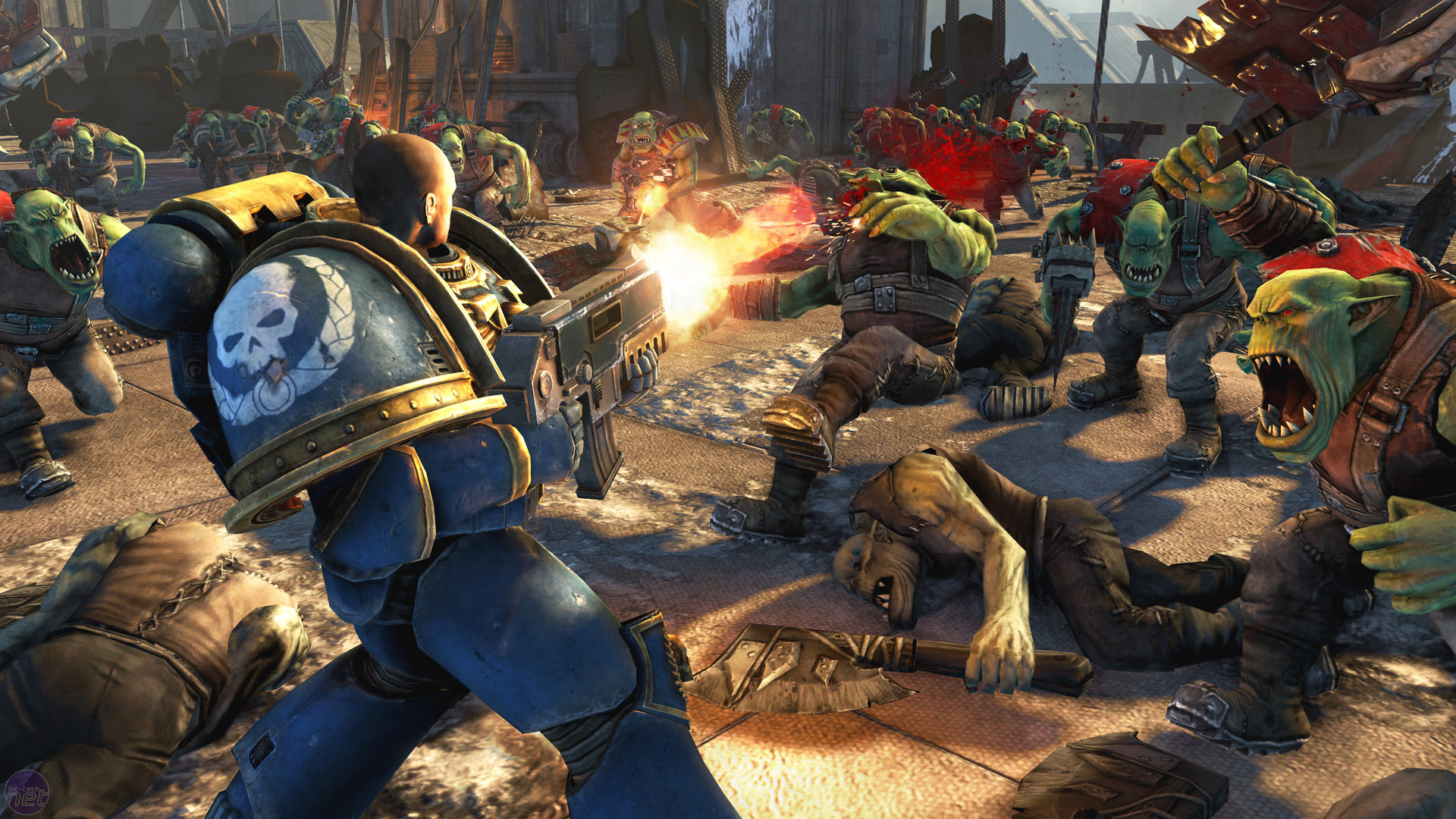
This guy is inevitably steel-thewed, his weapon is usually overlarge (projecting much?), etc. Alternately, maybe he has really ridiculous armor of some kind.

But Helmets are for Pussies!

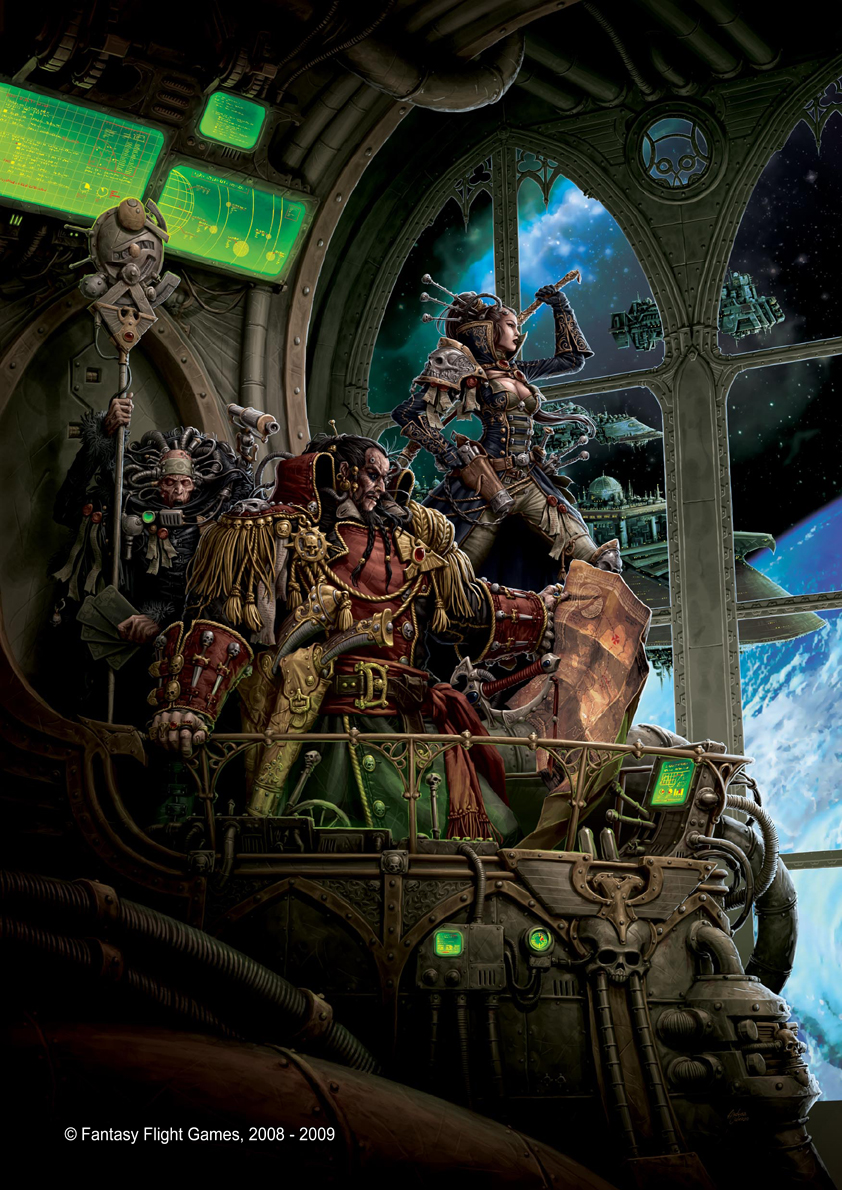
Sometimes, especially for fantasy RPGs, the cover features a Party of some kind, with the iconic character types of the game in question.

Like this.

Or this.

The cover art, in essence, projects a fantasy theme of some kind. Though Zak's post is talking more about game design than cover art, he also makes a critical point: Games, however they are designed, are designed for particular audiences, whether or not the author or designer conceives of his or her task as such, and even if that audience is conceived as a "general" audience. All communication involves an audience of some sort, even if that audience is vaguely defined, and, hell, even if that audience is a party of one(self). 

That is, to put this into the terms of my own area of scholarship, The Designer/Publisher (Source) puts out a Game (Message) to an Audience (Intended Audience), achieving some sort of Effect (or not). So, as regards the cover designs for RPGs, what the hell is going on here? Here are some things that Zak's post suggested to me (also borrowing somewhat haphazardly from Joseph Campbell, Karl Jung, and Ernest G. Bormann).

As audiences for RPG cover designs, we process the cover art as ourselves. This means that what we attend to, how we process it, and where that takes us are both socioculturally predetermined in some way and intensely personal. That is, we are who we are, as a result of where you are, when you are, and how, in particular, we come to be ourselves (both to others and to ourselves). We are individuals, certainly, but we don't make up from whole cloth how we are ourselves. We must draw on what's around us in order to express or communicate (or even recognize) "self."

Others may or may not be from the same "place" and will process these things differently (or similarly) as a result of how they are positioned, socioculturally and personally. Some of these people are pretty cool, and like what you like, and some are complete nutjob dickwad assholes. Some are both or neither of these things.

That is, we don't just process this artwork (or other design element) in the moment. We often use it as something that we project onto some future we envision. RPG books are not about looking at the cover and going, "Yeah that's cool." or "That sucks." Sure one can do that, but it's more likely that we are more interested in thinking about what can be done with it, or, more specifically, "What does this cover "say" about what the game is about, for me and the things that are important to me?"
However, we never just let the thing in question (e.g., the cover of an RPG book) simply "be itself." Not only is that not really possible (You can't just shut yourself off), it also is not particularly desirable, as it makes it pretty difficult to interact with others in constructing the collective narratives necessary for making RPGs "work." Ernest G. Bormann explains it this way:  "We are not necessarily persuaded by reason. We are often persuaded by suggestion that ties in with our dreams" (Ernest Bormann and Nancy Bormann, Speech Communication, 171). That is, we don't just process this artwork (or other design element) in the moment. We often use it as something that we project onto some future we envision. RPG books are not about looking at the cover and going, "Yeah that's cool." or "That sucks." Sure one can do that, but it's more likely that we are more interested in thinking about what can be done with it, or, more specifically, "What does this cover "say" about what the game is about, for me and the things that are important to me?"

An RPG cover, then, presents us with mythology, in the purest sense, the essence of what the thing is about. We project onto that thing based on what it shows us, who we are, and what it shows us about what we want. Some things don't push our buttons at all, so we don't care about them. Some things push the wrong buttons, and we instantly react negatively toward them on some level. But the important thing to remember is that, whatever the work in question, we are positioning ourselves with respect to it, or with respect to the people, places, or things we associate with it, all as a part of our viewing the cover of the RPG book.

So, when I look at this:

Hammertime, yo!

I process it differently than might someone else, and very differently from someone who is not interested in the themes and myths and so forth suggested by its iconography. Even when an RPG book doesn't have a stylized cover, other design elements are included. Even if it's just a blank, black cover, that "says" something  to the viewer. "Dude, where's the art?" or "Dude, this shit's so heavy it don't need no art!" or whatever.

One of the things I find so interesting about this dynamic is people's ability (or inability in some cases) to understand that a person's interaction with a game book (or game system) is, in fact, an interaction between self and the object. So, a person who fails (or refuses) to recognize that the fact that he or she thinks something "is awesome" or "sucks," is very much about that person, and not just about the objective thing in question. It is awesome because of you, not just because it, objectively, is awesome.

That said, when we get into a broader discussion of culture and aesthetics, we may, in a collective sense, have some sense of propriety about what is or is not "good," whether it be an artifact like an RPG book, or some object, style, or activity (e.g., the latest fad or fashion), or whatever. Sometimes things are seen, in a broader, collective sense, to suck donkey balls (This is necessary technical terminology, of course). Still, that consensus is built upon those shared themes and values appropriate to and appropriated by that particular community. This is, no doubt, why groups of gamers who value certain kinds of play, rulesets, and aesthetics can look across a divide that lies between them and wonder, "What the fuck is wrong with those people? Seriously, they suck!" And, no, I don't find it easy to get away from that, even knowing that part of that dynamic is me projecting my values onto those activities, objects, and people. I recognize that I'm doing it, but it's incredibly difficult to get any kind of distance between "me and mine" and "them and theirs."

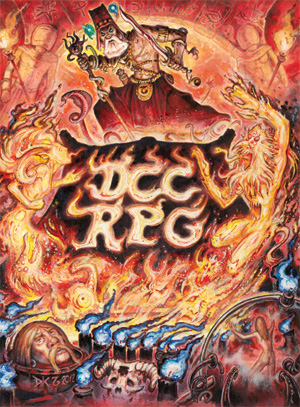
For me, in the end, to be able to enjoy a game, I have to be able to project some part of myself into the matrix of signifiers in and around the game in question. To me, that DCC wizard cover is badass in a very particular way. It hits some buttons for me. Same thing with Frank Zappa. Other people may, at best, be amused by me and the things I think are cool. I think that was Zak's original point about design: There is no objectively well-designed game that doesn't account for particularity of players and play styles. If a game only has one generalized player in mind, then it misses the point that only people who like that kind of thing will like it in particular. The mechanics may work well. It might be systematically developed and presented in sound ways. However, it can still suck for some players or groups, especially if those players or groups are unable to find space in which to project their own fantasies onto the object (e.g., the book cover) or system (e.g., Dungeon Crawl Classics) in question.

Games that make it possible to project those fantasies in mechanically interesting ways, I think, provide much greater opportunities for broader groups to enjoy them. They may not do anything perfectly in a mechanical sense, but they provide enough wiggle room for particular groups of players to make it work, and work well, for them. That's great, because it makes possible to have gaming experiences where the players can make the experience about them, but allow other players to do the same thing for themselves. Hell, the GM has more freedom in this scenario, as well, to incorporate what the other people bring (of themselves) to the gaming table. Everybody is creating this cool thing (or not, because maybe you just want to chill out and watch your crazy friends do their things), and it's fun. What's not to like about that?

As far as the recent discussion of sexism in games, this also is apt. When one sees "blatant" sexism, then perhaps, objectively, there are elements there from which one can make this judgment (see Conan picture above). Submissive female figure, chainmail bikini, and so forth. However, to ignore that part of what one "sees" involves the projection of one's own shit (sociocultural, personal, etc.) onto that set of signifiers is to mistake the relationship between oneself and the object in question. "It" is not the problem. "It" is a condensation symbol for a variety of other meaningful things. Meaningful in many senses, including very, very personal ones. So for someone to call something objectively sexist ignores that such a judgment must be made from a position from which the particular judge is, well, judging. Sexist. To you.

This is not to say that in broader, cultural sense that some things aren't generally accepted as bloody fucking awful. We do, as a people, find thing we can agree to love or to hate. We do it very naturally. We do it in ways, also, that allow us to form in-groups and out-groups, and to make judgments of various sorts about people, things, activities, and so forth that we like or to which we object. It would be a mistake, however,  to assume that this judgment of those people, things, and activities is any more objective, simply because it is broadly accepted as "true" by a particular culture.

That said, I, personally, can and do make value judgments about people, things, and activities, and do it all the time. It's what allows me to have a sense of what is or is not good/bad, ethical/suspect, etc. I cannot, however, imagine that what I do now will look the same to someone 50 or 100 years from now (or before now). Different context means, usually, different judgments. However, I don't like people who treat women like crap. But when I say that, I don't mean that those women must somehow accord with some fantasy I have about their objective level of subjugation by the Patriarchy. I mean how those women are interpellated (i.e., "called to accept a particular social relationship") into a particular model of feminine virtue. What choices do they have (or are they permitted)?

For me, their agency in the situation is the point. I don't object to women's personal decisions about their sexual lives, or whatever, because its not my choice. It's theirs. Nor do I think that an artist drawing a woman in a chainmail bikini is objectively sexist, as some do, because women are not required as a result of that piece of art, to don such a garment or to accept a subservient position (as if those are synonymous, anyway). I don't object to a woman's choice to act submissively or to adopt the so-called "Gorean" lifestyle, as some do, provided it is, in fact a choice. Objectively, then, no problem, provided the woman in question actually has agency in the situation. Subjectively, though, I don't get it, and don't care for it. I think Goreans are fucking creepy. I think men who think about women as objects to be used are assholes. But I recognize my judgment is at work, here, just as much as in the case of the person who values those things. I may have culture on my side, for now at least (Fuck you, Rick Santorum.), but I am making a subjective judgment.

Still, I might be inclined to make statements about such things, to judge those people and those activities as "fucked up" or whatever. But then I wonder why I'm reacting to them, and realize that it's at least as much about me as it is about them, and I can accept that. The real trick is in being able to do both of these things (i.e., subjectively judging or being objectively ambivalent) at the same time, without thinking you're doing one or the other exclusively. So, "That sucks, but have fun with it. Over there. Waaaaay over there." I can do that: Subjectively objective, that's me.

Tuesday, December 18, 2012

Zappadan, Day 15: Diseases, Imaginary and Otherwise

Here's a little ditty about how marketing people at some point decided to create problems to associate with their New! Improved! solutions. It's a satirical examination of the role of marketing, posing as actual science--Throw a labcoat on that actor and he's a doctor!--to extend the consumer's attention to things which had never previously been a concern (bad breath, stinky feet, that "not so fresh feeling"), and, most importantly, to sell them a product, preferably one that can be marked up to something like 100 times the value of its component parts. This is the modernist equivalent of the snakeoil saleman.


I think maybe it's worth commenting here that we are very good in the gaming community at imagining how physical harm might be done with spell or sword, but pay much less attention to the other minutia of daily existence for human (and demi-human) beings. How often do your PCs have to deal with things like allergies, crummies in the tummy, a bad head cold, diseases acute and chronic, and that sort of thing.

While I recognize that many systems account for these things, as well as similar effects engineered with poisons, it has not been my experience that these things really make it into gameplay, unless of course it's as an adventure hook of some kind (e.g., Plague Rats of Nurgle, or some such thing). I think there are some good reasons not to include them. They're mundane, for the most part, and kind of depressing. They kill the whole heroic vibe. Conan with explosive diarrhea is just not as awesome, somehow. Oh, good. Now I'm going to have to live with that image in my head. You will too. You are welcome.

In some video games (Skyrim comes to mind), you can get diseases, of course. Then you simply go to Ye Olde Potion Shoppe and buy a potion and *poof* you're cured. That's not really a very difficult effect to overcome, except possibly at very low level, when you're pretty much broke most of the time. Once you have a bit of gold, it really isn't much of a big deal at all. That seems sort of a wasted effort, to me at least. If diseases don't actually do much harm, and if they're so easy to cure (and instantaneously!), then what really is the point of have them as elements of gameplay?

On the other hand, what if you have diseases that are dangerous, contagious, and either difficult or impossible to cure without specialized help (like a cleric of some god of healing/purity, etc.). That is, what if not every healer is able to heal them? What if there is an object or substance that is required to cure them? Then things are more complicated. That creates a quest. That could result in some neat gameplay.

However, that doesn't really get at the more mundane forms of disease, like the common cold, not to mention such diseases as are common, uncomfortable, but generally not deadly (e.g., chicken pox). As anyone probably knows, a bad cold can lay a person out for days at a time. Some forms of the flu are very, very dangerous. If an adult catches some childhood diseases, it can be deadly or can lead to side effects like sterility. So, these sorts of things can have short-term effects on the person's ability to do routine things. They might affect the person's overall state of health, and thus their ability to deal with new problems that affect one's health.

When you GM a game, do you ever use diseases in these more mundane ways? Do your PCs ever get a bad cold? Do they get STDs if they go out whoring? Do they suffer from hangovers from overindulgence in alcohol (or the Purple Meat, for that matter)?

For myself, I'd have to say I'm on the fence about these things. Yes, they add more "grit" and "grim-dark," and more "realism" to the game. Fine. But I also worry that they're just another book-keeping nightmare for the GM, or that players might just see such things as the GM being a dick (and just to be a dick). So, I tend not to use diseases and other disease-like physical effects. Perhaps, though, I've been wrong to do this.

Diseases are often terrifying. They can be deadly. They can become the center of one's universe until (and unless) one recovers. Even when that happens, there can be long-term effects. What if, for example, polio was a thing in your game world? That could create all kinds of problems for PCs. What if epidemics of influenza, cholera, smallpox, The Plague, etc., were common, or at least real threats to the PCs and their efforts in the game world? There's another potentially interesting way to create an interesting in-world effect.

Further, what if the PCs themselves become vectors of the disease in question, either because they are affected or because they are carriers of it (Thyphoid Mardok the Barbarian)? More potential in-game complications would be possible in such a situation.

So, to sum up, I think I'd like to use more diseases in my games, but not as short-term, forgettable, or otherwise inconsequential factors, but as part of the game world itself. This would include in-game effects on the PCs of course (e.g., stat drain, penalties to actions and/or saves, long-term effects on the PCs' physiques, etc.). It would also include things like determining if, how, and for how long outbreaks of particular diseases would occur. It could also, and I think this is the really interesting part to me, make consequential the choice of where one eats, drinks, and sleeps. Why pay for an inn that is of higher quality? Because eating bad food with filthy peasants can make you sick or dead. That's why the extra coin is worth it. When the choice of an inn is (potentially) a life and death choice, then it makes even mundane in-game decisions consequential.

If you include other things that could affect characters, like lack of sleep, saddle sores from long rides, the consequences of marching long distances in worn-out boots, failure to launder one's clothing resulting in infestations of nits and fleas, getting the drizzling shits from bad water or food, then all of a sudden you've made the world a deadlier, dirtier, and less pleasant place. You cleric becomes more than a healer with a club. He or she must also consider healing and health in a more holistic fashion (avoiding disease is a good way to avoid having to heal it). Players then become a whole lot more particular about things that normally get hand-waved in many games.

I suppose that getting things to that level of detail could slow down play or make the world to much like the real world for comfortable assumptions to rule the day. Hell, I may not even do anything like this for just those reason. However, having such factors be a part of the game will certainly make it more immersive, lead to enhanced role-playing, and help to add complexity to players' approaches. It won't be all about killing monsters and taking their shit, though of course these will still be primary. However, those will be means to an end: PCs are tired of living in disease-ridden squalor. That's why they are willing to face all of those terrifying foes. Because they know, in the end, the foes most likely to kill them are the ones they can't see. Some creatures are horrendous, but they are easy to understand, and the solution is usually no further away than the point of a spear or edge of a sword. Pestilence, disease, starvation, and myriad other aspects of Death, however, get short shrift in a game that's all about the war aspect. And that's a crying shame. Death must have its due, and it will take its due however it can get it. By blood or by pus, by sword, disease, or famine, Death will have its reckoning. That seems like something worth having in an Old School game, even if they are only imaginary.

Saturday, December 15, 2012

Zappadan, Day 12: On the importance of context

Today I will present without too much additional comment a full concert video from a Zappa show in Barcelona (1988).

I got to see Zappa live in 1984, at the Arlene Schnitzer concert hall in Portland, Oregon. I was 15 years old, I think. I drove up with my friend, Dale, in his '64 Ford Falcon. It was snowing that day, and we were fearful that we'd not be able to make it. But we did, and it was awesome. It was one of the best shows I've ever been to (along with Oingo Boingo), and a formative event.

The lesson, here, is one of context. A lot of the videos I've presented during this series were single songs or interview clips. Taken in isolation, they say something particular. However, they can also be understood in a broader context of history and as parts of a larger "text" of Zappa's (and his cohorts') works and lives. Those additional  parts are largely ignored in watching the singleton videos. Seeing a full concert is a bit more encompassing, though even it doesn't really look at the longer span of the man, his bands, and their collective history as a musical act from the 1960s onward.

When we look at the various games that we, as a collective of gamers, play, we have a tendency to hack, tweak, excise, or otherwise manipulate the various rulesets. We houserule everything, almost by reflex. Yes, sometimes we caution ourselves that it's important to play the game as-written before doing so, but I think that doesn't always happen. I'm not saying that it's a mistake not to play it as-written, mind you, but it is something different than was was intended by the author(s)--and, no, I'm not going to get into broader discussions of authorial intent. Suffice it to say that I'll assume that the games as-written were made purposefully to work as they do.

If we approach those games humbly, accepting them as-written, we might not find the game we really want to play. But we do get something from which we can learn if we're not too caught up in our own cleverness, in form of a relentless foisting upon the games our own proclivities and quirks. We may lose something vital that's only present when we play the rulesets in their original form. I'm wondering if perhaps this is part of the urge to recreate The World's Most Popular RPG in it's original form, or from it's original authors' intentions and notes, or whatever. We're trying to see the thing as itself, free from the accretions of decades of tweaks, changes, modifications, additions, supplements, houserules, etc. We are trying to see the face of the creator, as it were, and there to glean some essential experience and/or knowledge not available to us otherwise.

I, for one, am doing my best to play Dungeon Crawl Classics as-written. When my cleric can't make a spell roll, it sucks. When he can do so, or when my warrior (Thumpy McStabsalot) crits a monster back into the shadowy hell from which it sprung, then it's awesome. If I tweaked these rules to make the outcomes less quirky and random, it simply wouldn't be the same game. DCC is about Shit Happening. Sometimes said Shit is pure epicness with awesome sauce. Sometimes it's a greasy shit sandwich on stale bread. That's DCC. That's what it brings to the table: The opportunity to create an epic tale of might and magic... and of suckage and haplessness. It makes for some great stories. And it is freakin' awesome. They meant it to be that way, and that's how I'm playing it.

This is not to say that all rulesets are equally well thought out or playable. They're not. But I think it's pretty important to play them through the first few times with a sense of humility and curiosity, to be attentive for the unique facets of each ruleset, as-written. That makes for excellent opportunities to learn and become wiser, to become gaming wizards in the original sense of that word:

wizard 
c.1440, "philosopher, sage," from M.E. wys "wise" (see wise (adj.)) + -ard. Cf. Lith. zynyste "magic,"zynys "sorcerer," zyne "witch," all from zinoti "to know." The ground sense is perhaps "to know the future." The meaning "one with magical power" did not emerge distinctly until c.1550, the distinction between philosophy and magic being blurred in the Middle Ages. As a slangword meaning "excellent" it is recorded from 1922.


So, now... watch the Great Wizard Zappa as he goes about his work. There's something to be learned.


Monday, December 10, 2012

Zappadan, Day 7: Pushing the Boundaries

One of the things I like best about Zappa is the fact that he pushed a variety of boundaries, both musical and cultural. Here's a clip of him discussing Alice Cooper on the Mike Douglas show.


The most significant takeaway is his take on how, when Alice Cooper played, a bunch of people would leave. He saw that as a positive thing, because it suggested a level of discomfort with the music. Maybe the audience was unable to process it in the ways to which they were accustomed. Maybe they were able but found it distasteful. Whatever it might have been, it wasn't what they wanted, so they left.

This is a lot like some of the discussions over the last few years about Carcosa, Lamentations of The Flame Princess Grindhouse Edition (and the various LoTFP modules), etc. These are works which spawned a strong reaction, and a lot of negative reactions on top of it. Zak Smith has been someone who has worked tirelessly (probably because he also has been the target, repeatedly, of this sort of thing) to push back against people who were uncomfortable with this sort of thing, and, for whatever reason, thought they just had to push back against it.

But here's the thing. It's good to push your own boundaries occasionally. For example, I have a lot of music, and some of it is "challenging." It's weird, hard to listen to, loud, noisy, unpleasant, or whatever. Hell, some of it I don't even like very much. But I listen to it anyway. It reminds me that I'm not the only person in the world who likes music, and that what I like is a very personal decision. When something is not to my taste, it reflects where the boundaries lie between me and what is outside of me. Sometimes I keep checking these things out and discover that, hey, this actually is pretty interesting stuff (e.g., The Minute Men, some of the early, experimental punk/new wave stuff, and, yes, some of Frank Zappa's own work). Some of it I try and then decide that it's just not for me.

What I don't do is then go and decide that, just because I don't like it or don't approve of its moral or aesthetic frame, that it SUCKS and the people who like it are BAD AND WRONG!!!11eleventy!

To paraphrase, Zak S., liking pancakes is fine. Liking waffles is fine. Not eating breakfast at all is fine. But if I want some damned pancakes, then you don't have to eat them. Don't get in my face about how pancakes suck and I'm an asshole for liking them, and how I should only eat whatever it is that you eat because it's so morally and aesthetically superior. Fuck you! I like pancakes!

That's why I love the stuff that people like James Raggi produce, even if I don't play it myself. That's why I love it when people twist the standard gaming tropes in ways that are weird (e.g., gonzo approaches to regular fantasy and sci-fi). That's why I like outsider cultures in general. It's not the mainstream, it's weird, it makes a lot of people uncomfortable. I think that's a very, very good thing. Comfortableness is just a step away from stagnation.